
$1.5 Trillion Transacted: Rain Report Reveals the Massive Scale of Latam’s Stablecoin Economy


The crypto card company stressed that these volumes result from a more conscious use of stablecoins, driven by concrete problem-solving rather than by speculative or purely transactional objectives, unlike those in other markets. Colombia and Bolivia are among the highest-growth markets.
Key Takeaways:
- Rain reported Latam processed $1.5T from 2022 to 2025, cementing stablecoins as market reserve assets.
- Fleeing their currency’s devaluation, users can cut transfer fees by 92% by using stablecoins.
- Driving alternative finance, Rain cardholders grew 64x in Colombia in 2025 to serve unbanked users.
Rain Report Underscores Large Growth Of Crypto Cards In Latam
Rain, a company that provides the infrastructure for issuing stablecoin-backed crypto cards, has revealed significant growth in the use of these tools in Latam.
In its recent “State of stablecoins in Latin America” report, Rain declared that the region had transacted nearly $1.5 trillion between 2022 and 2025, with the majority of these flows intermediated by stablecoins, a testament to their adoption as dollar proxies in the region.
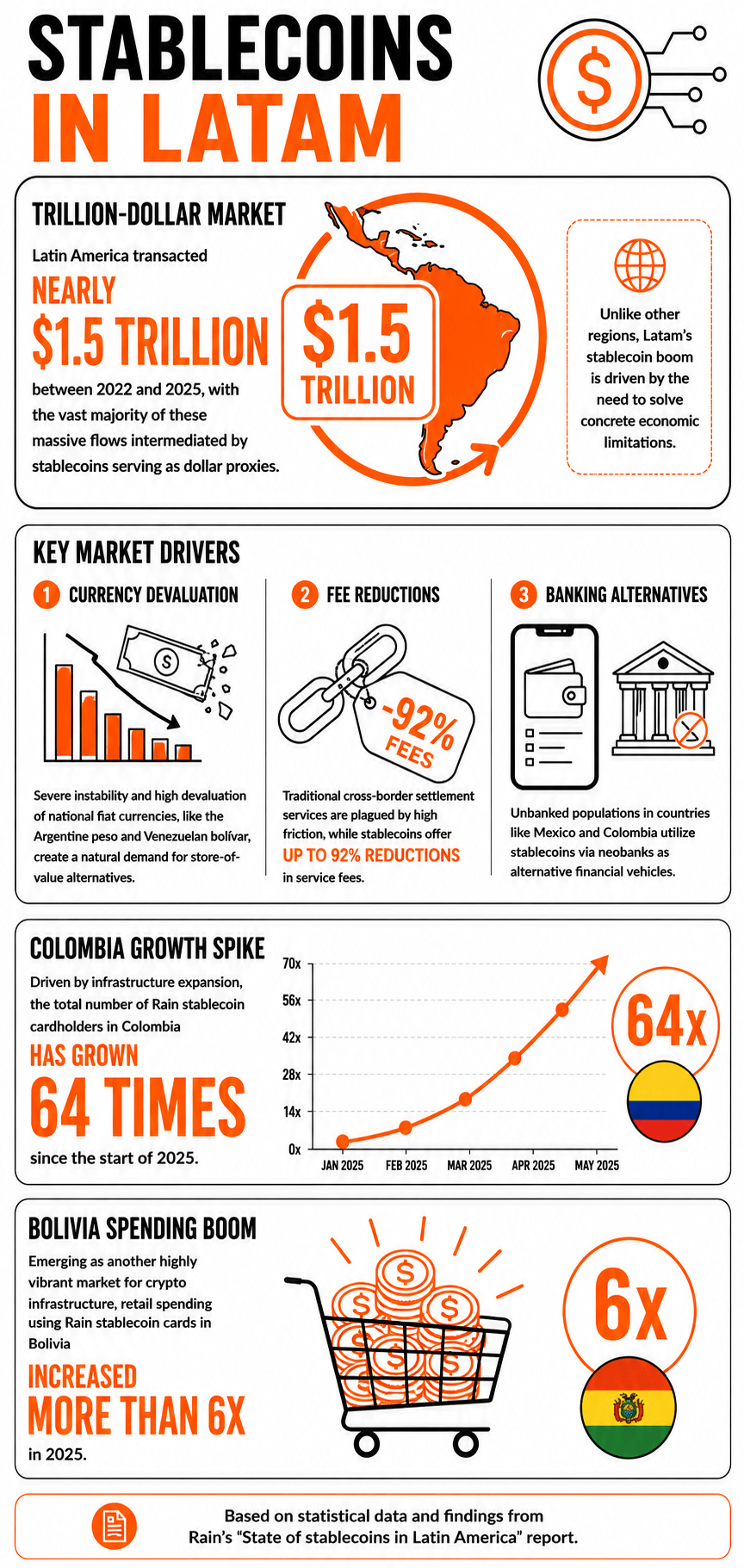
This adoption, unlike in other regions, is driven by their ability to solve concrete problems originating from the economic limitations some of these countries experience.
Among these key drivers are the instability and elevated devaluation of the currencies in the region, including the Argentine peso and the Venezuelan bolívar, which have lost a large part of their value in recent years.
This results in a natural demand for a currency that can act as a reserve value when national currencies.
Another factor pushing stablecoin adoption is the high fees that plague cross-border settlement services in the region, with stablecoins presenting reductions of up to 92% in service fees.
The third element that powers stablecoin adoption is limited access to banking services in countries like Mexico and Colombia, where stablecoins can perform as alternative finance vehicles via neobanks.
Rain singled out Colombia, where the number of Rain cardholders has grown 64 times since the start of 2025, and Bolivia, where spending with Rain cards increased more than 6x in 2025, as vibrant markets in the region.
The company stresses that as long as these unfavorable conditions persist, demand for stablecoins and the infrastructure to manage them, including cards, will persist.
“The use cases that have taken hold across Latin America, and the infrastructure being built to support them, represent some of the clearest real-world examples of stablecoins meaningfully impacting how consumers and businesses operate financially,” Rain concluded.