


Ethereum ($ETH) price trades near $2,055 on April 3, sitting inside an ascending channel on the 8-hour chart that has guided price action since February 24.
The channel represents the only bullish structure $ETH has maintained since the early February crash. However, three signals underneath the surface, smart money indecision, a bearish RSI divergence, and a whale pattern that historically failed to prevent corrections, suggest the channel’s survival is increasingly in doubt.
Smart Money Mirrors a Pattern That Preceded a 43% Crash
The Smart Money Index (SMI), an indicator that tracks informed investor behavior, is currently tied with its signal line on the 8-hour chart. The two lines are currently intertwined, showing that informed participants have not committed to a direction. Doji candles on the 8-hour timeframe confirm the same indecision at the price level, where neither buyers nor sellers have gained control over the past two sessions.
Want more token insights like this? Sign up for Editor Harsh Notariya’s Daily Crypto Newsletter here.
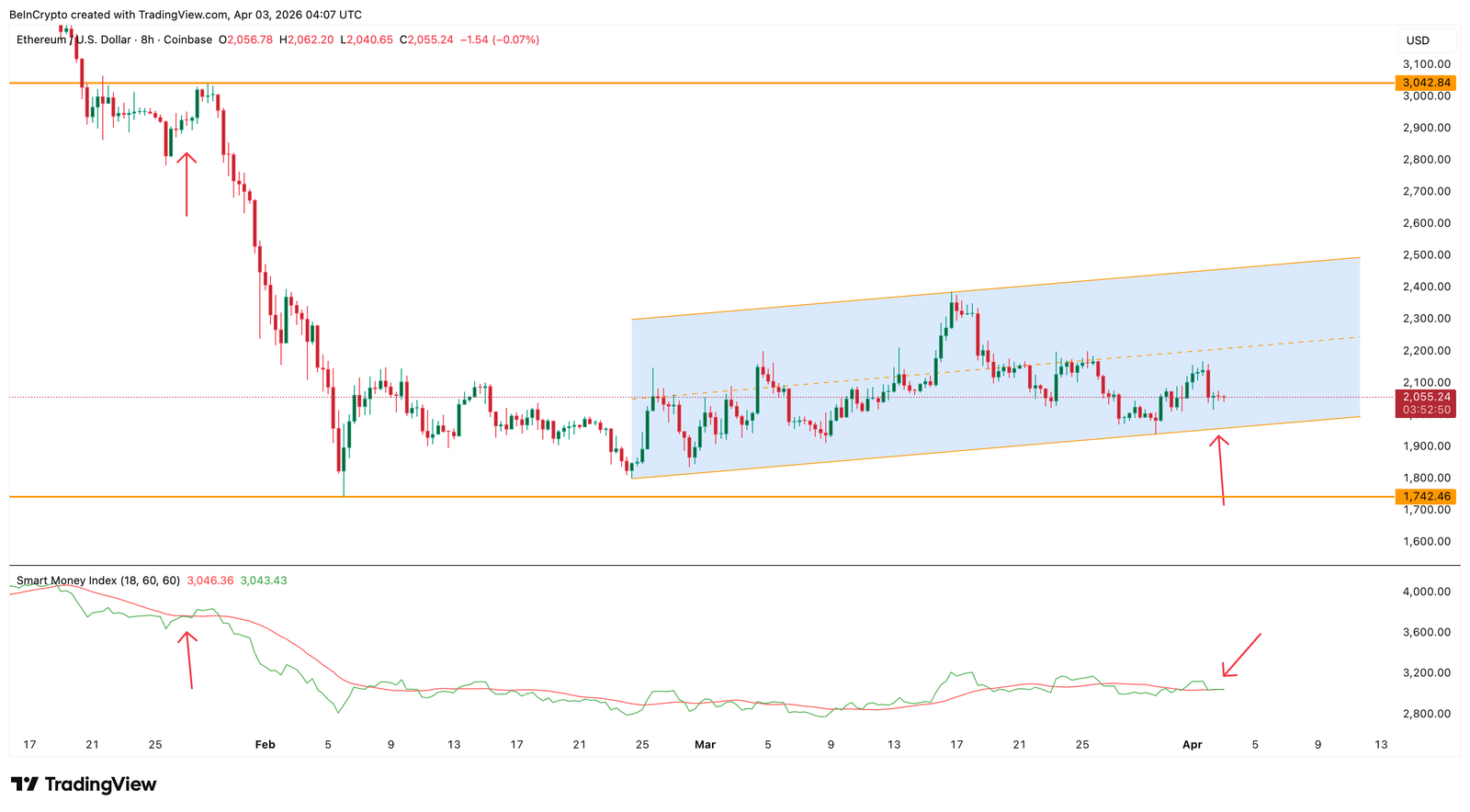
$ETH Smart Money Indecision: TradingView
This matters because a nearly identical setup appeared in early January. The Ethereum smart money indicator hugged the signal line for several sessions before eventually disconnecting to the downside after a quick rise. During that period, Ethereum price crashed 43% from a peak of $3,042 on January 28 to $1,742 by February 6. The current flatline carries the same structural signature.
The Relative Strength Index (RSI), a momentum oscillator, adds weight to the bearish case. Between February 25 and April 1, price on the 8-hour chart made a higher high inside the ascending channel. RSI, however, made a lower high over the same period. That standard bearish divergence signals weakening momentum behind the price advance.
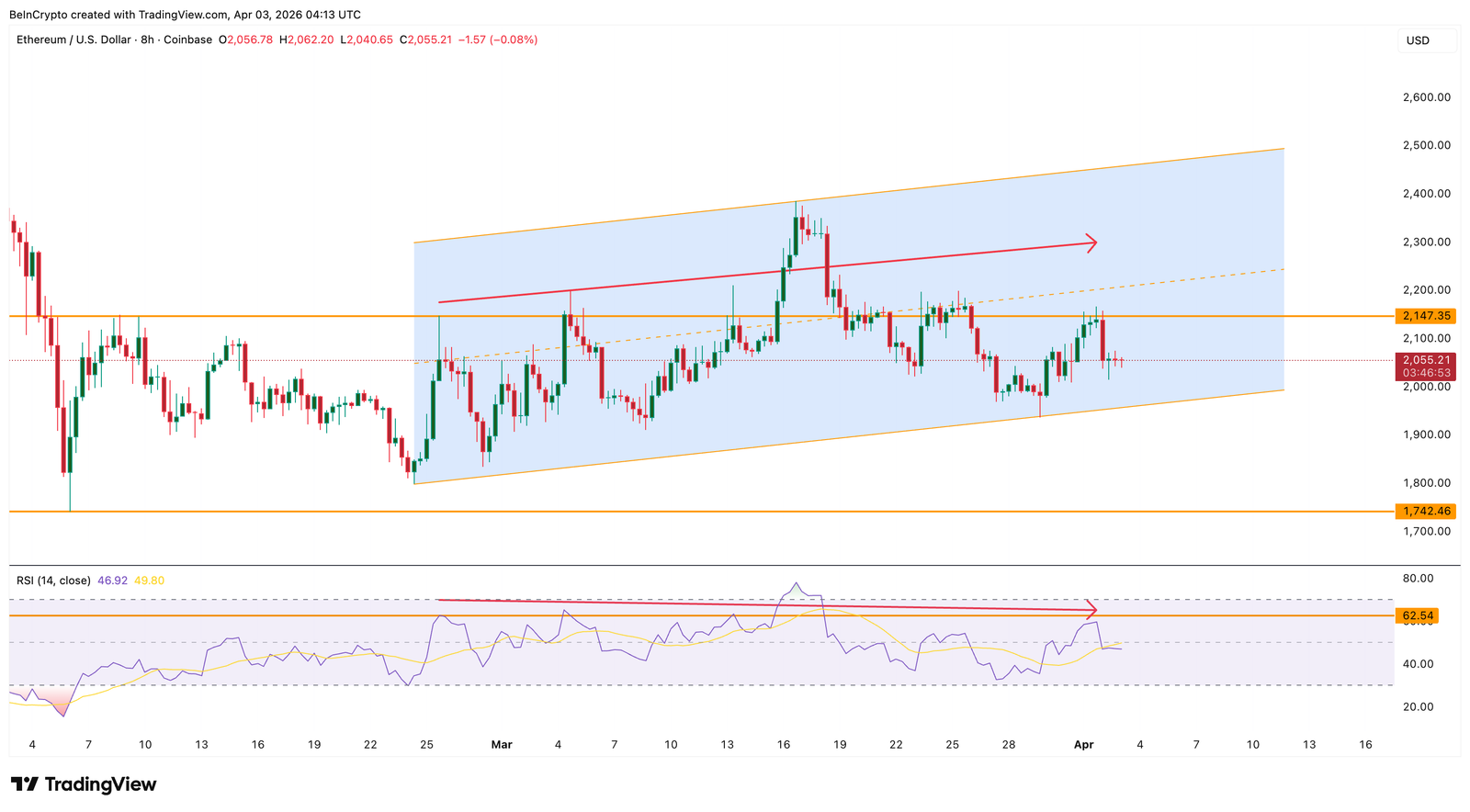
RSI Bearish Divergence: TradingView
Since the divergence was confirmed, the $ETH price has already started pulling back. The combination of smart money indecision and fading RSI momentum raises the question of whether whale activity can provide the floor that technicals cannot.
Ethereum Whales Keep Buying, but History Urges Caution
On-chain data from Santiment shows that Ethereum whales, wallets excluding exchange addresses, have been steadily accumulating since March 24. On that date, whale supply stood at 121.69 million $ETH. By April 3, the figure had climbed to 122.98 million $ETH, an addition of approximately 1.29 million tokens.
The accumulation has been consistent rather than sudden, with another noticeable uptick since April 3. At current prices, the 1.29 million $ETH addition represents roughly $2.65 billion in value. On the surface, this kind of buying pressure from large wallets typically supports a bullish case.
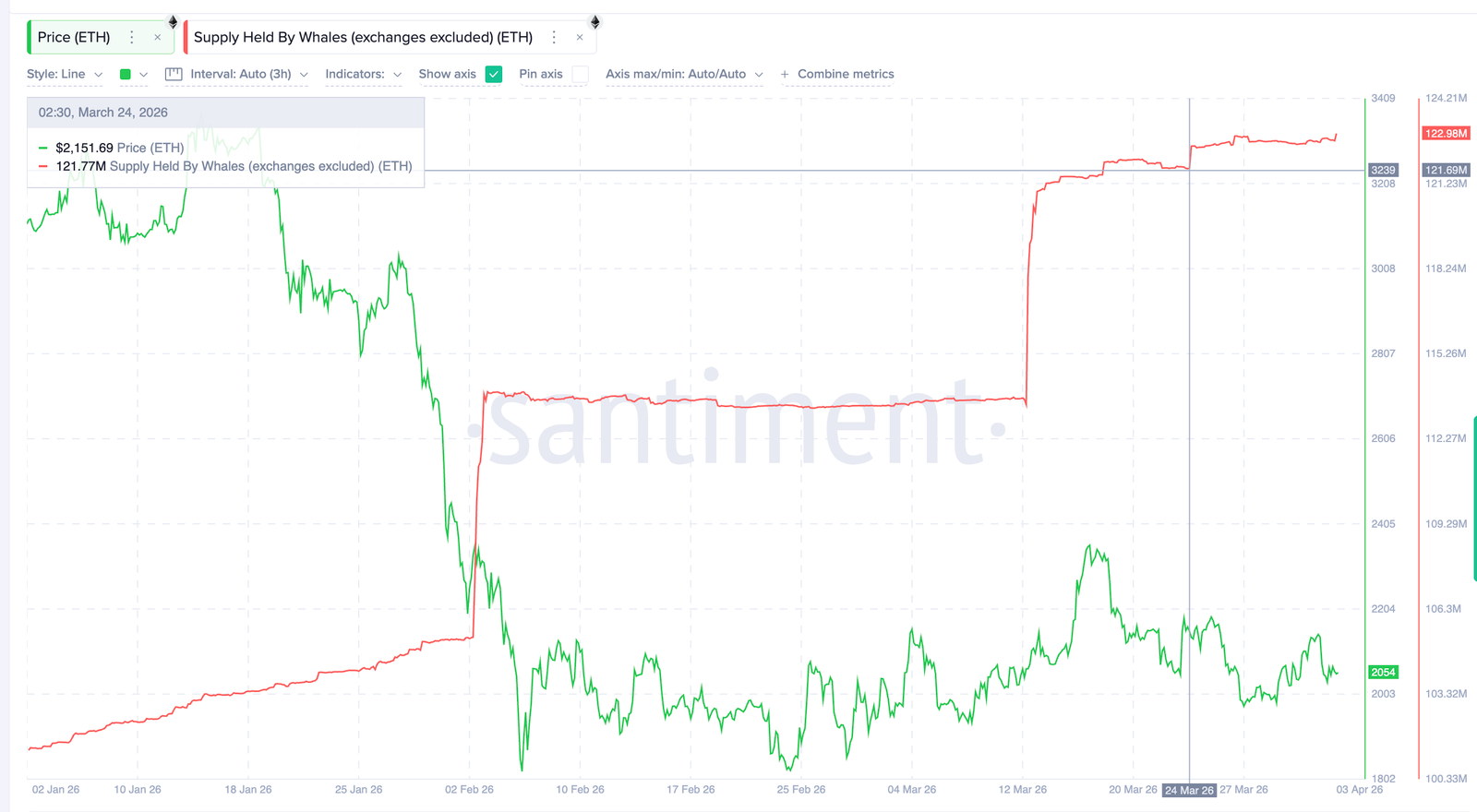
$ETH Whale Supply Accumulation: Santiment
However, the January precedent undermines that interpretation. Between January 28 and February 6, while Ethereum price fell 43%, whales did not stop buying. They added to their positions throughout the crash, either accumulating for the long term or getting caught in a declining market. The current accumulation follows the same pattern, occurring alongside weakening momentum indicators.
That pattern raises the risk that the current accumulation is less a vote of confidence and more a familiar trap where large buyers absorb supply while the broader structure deteriorates underneath them.
Whale buying alone did not prevent the February correction, and the presence of smart money indecision alongside RSI divergence suggests it may not prevent one now either. The ascending channel and its key levels now determine where $ETH goes next.
Ethereum Price Eyes the Channel Floor
The 8-hour ascending channel frames every critical Ethereum price level. $ETH currently trades at $2,055, sitting between the 0.5 Fibonacci level at $2,093 and the 0.618 level at $2,024. The $2,024 zone acts as the lower boundary of the channel and the most important support.
A daily close below $2,024 would weaken the ascending structure that has held since February 24. That breakdown aligns with the smart money indecision and RSI divergence from the prior sections. Below the channel, the 0.786 Fib at $1,925 becomes the next target, followed by $1,800, a zone that sits just above the February 6 crash low of $1,742.
For the bearish thesis to fail, Ethereum price needs to reclaim $2,162, the 0.382 Fib and almost the swing high from April 1 that formed part of the RSI divergence. A move above that level would indicate that smart money has chosen a direction and invalidate the momentum weakness. A push past $2,387 would bring the bullish case back into focus.
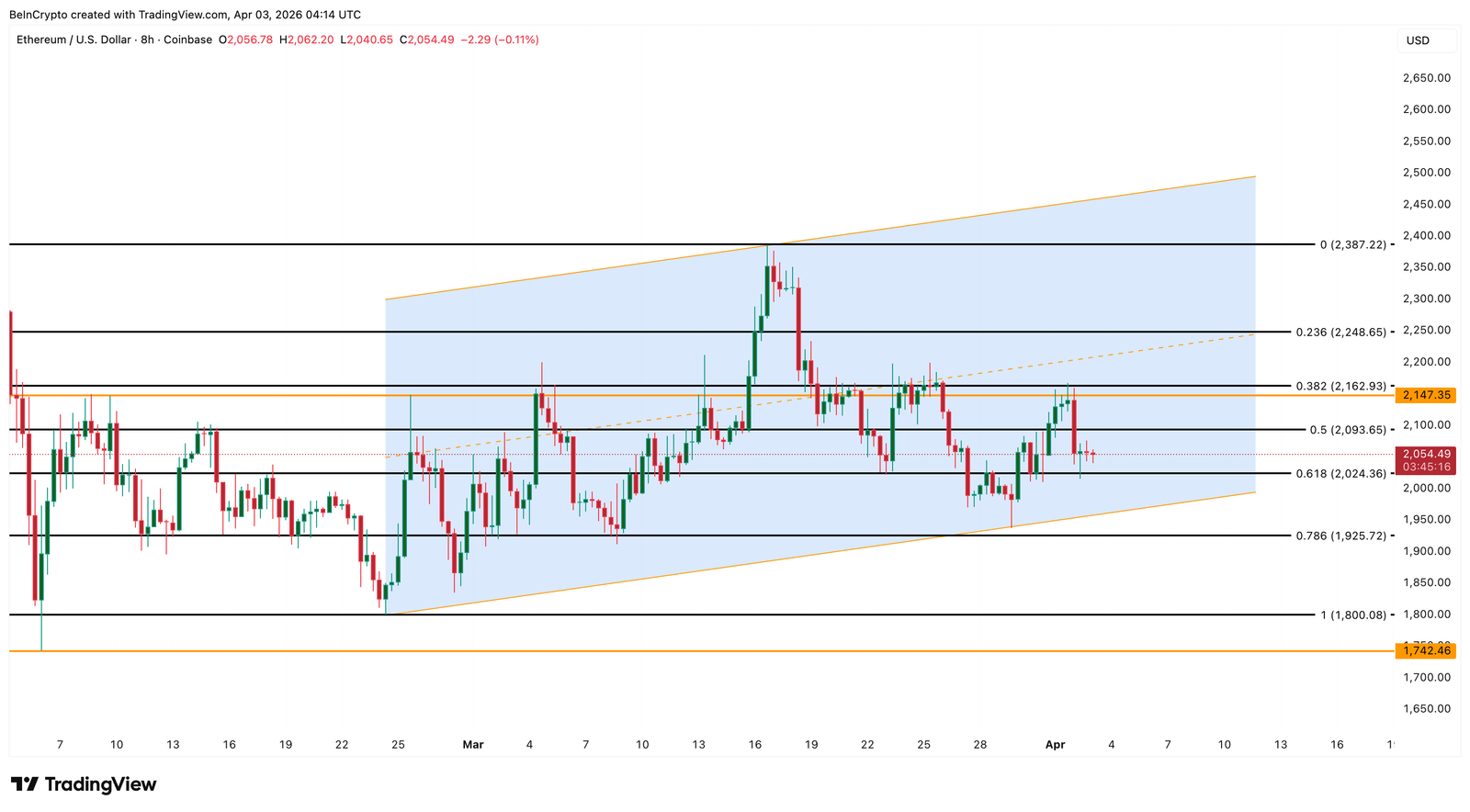
Ethereum Price Analysis: TradingView
Ascending channels after extended declines carry continuation risks rather than being automatically bullish. The channel has provided structure, but the internal signals are deteriorating. If oil-driven macro pressure persists alongside the smart money and RSI weakness, the channel floor at $2,024 faces a genuine test.
A daily close below $2,024 separates a controlled correction toward $1,925. That would open the $1,800 zone. Yet, reclaiming $2,162 would be the first evidence that the bullish structure has survived, for now.