

FUD hit the crypto market in Q2 following a massive shakeout in TVL.
Notably, this wasn’t just the result of weaker price action. Instead, back-to-back protocol exploits resulted in more than $600 million in cumulative losses, triggering widespread capital outflows as users rushed to unstake assets and reduce their exposure to DeFi protocols.
To put the scale of the drawdown into perspective, more than $20 billion exited DeFi protocols during the quarter, pushing total value locked (TVL) down to roughly $70 billion from its pre-October 2025 high of around $150 billion. That represents the sharpest quarter-over-quarter decline in TVL since 2021, highlighting just how quickly market participants shifted into a risk-off stance.
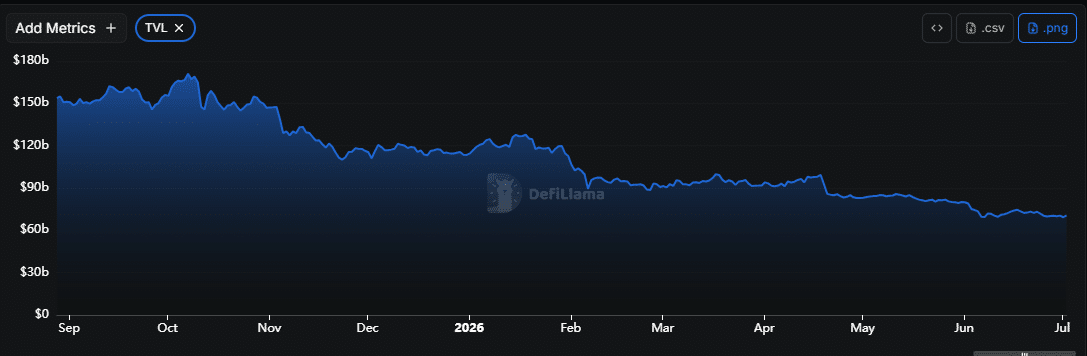
Source: DeFiLlama
Aave [AAVE], the largest lending protocol, was a prime example of this trend.
As AMBCrypto reported, following the KelpDAO exploit, Aave’s TVL dropped roughly 18% to $17.8 billion within 24 hours, as users rapidly withdrew liquidity from the protocol. The selloff wasn’t limited to Aave, though. Fear quickly spread across DeFi, driving liquidity out of other protocols and pushing Ethereum’s TVL down by more than $10 billion.
Now, however, the trend may be starting to reverse. Aave on Ethereum recently recorded 1,806 new wallet addresses in a single day, its strongest network growth since October 2021. While one day of data isn’t enough to confirm a recovery, it does suggest that interest in DeFi is picking up again.
Naturally, the question is: Is this the first sign that the market is bottoming ahead of a potential Q3 rally?
DeFi rebounds as stablecoin inflows signal returning risk appetite
Stablecoins are often one of the clearest indicators of where capital is flowing.
Notably, that trend is already emerging in Q3. Stablecoin liquidity has been building across several major L1 networks. Solana ended Q2 2026 with a record $16.6 billion in stablecoin supply. Stellar also saw momentum pick up, with its 30-day stablecoin transfer volume rising 32.6%. Cardano is showing a similar pattern. According to DefiLlama, the network’s native stablecoin supply has grown 20%+ over the past week.
Taken together, these metrics paint a clear picture. Stablecoins are moving back on-chain, TVL is beginning to recover, and activity across major DeFi protocols is picking up. That view gains further support from CryptoQuant’s latest report, which showed CeFi lending contracted 6% quarter-over-quarter to $23.3 billion, its first decline since Q3 2024.
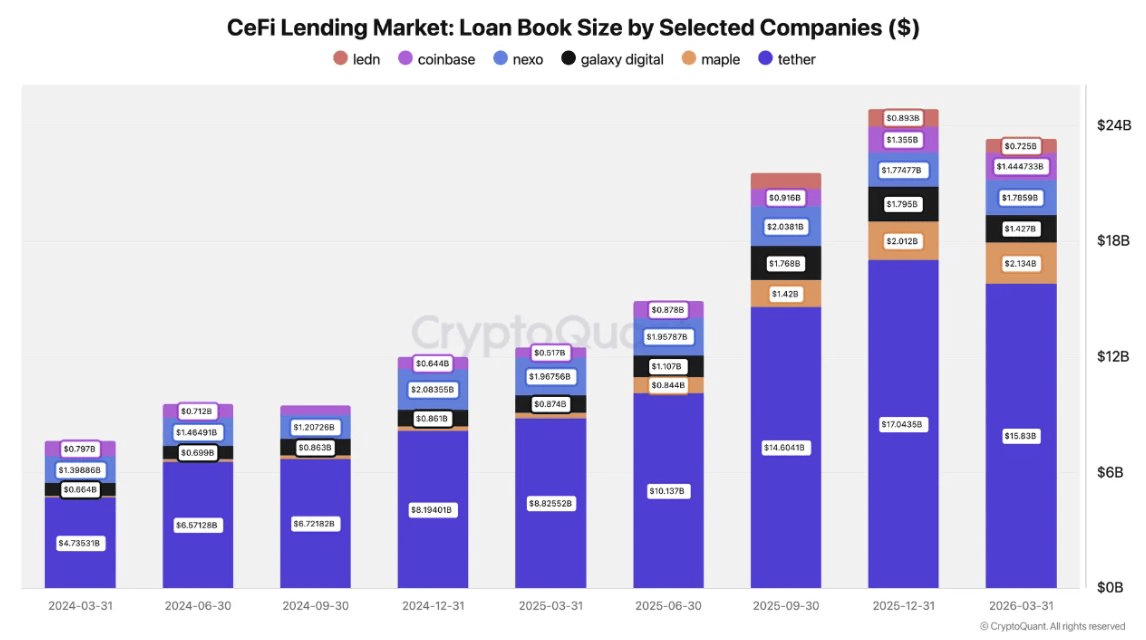
Source: CryptoQuant
The takeaway is fairly straightforward.
As activity slowed on centralized lending platforms, liquidity appears to be finding its way back into DeFi, suggesting investors are becoming more comfortable deploying capital on-chain again.
If sustained, this CeFi-to-DeFi rotation could mark one of the first measurable signs that Q2’s risk-off sentiment is fading, potentially laying the groundwork for a broader crypto recovery in Q3.
Final Summary
- DeFi is showing signs of recovery as stablecoin inflows increase and Aave’s network activity rebounds.
- Falling CeFi lending and rising on-chain liquidity suggested that capital may be rotating back into DeFi ahead of Q3.