


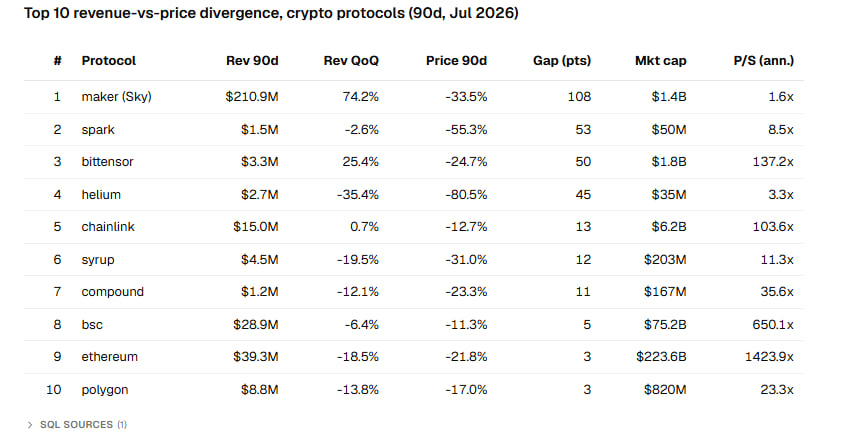
Crypto investors are seeing a growing gap between how blockchain networks perform as businesses and how their tokens trade. Market data showed Maker’s Sky generated $210.9 million in revenue over the past 90 days, the highest among major protocols, even as its $SKY token fell 33.5%.
The disconnect stretched beyond the largest projects. Spark’s token dropped 55.3% while its revenue slipped just 2.6%, and Bittensor increased revenue 25.4% to $3.3 million despite its token losing 24.7%. The figures suggest protocol revenue is becoming less closely tied to token prices, even as investors continue to judge projects largely by market sentiment.
Sky Shows the Widest Fundamental Gap
Sky posted the strongest quarterly revenue growth among the 10 largest crypto projects, with revenue rising 74.2% from the previous quarter. Despite that performance, its $SKY token fell 24.5% over the past 90 days and 27.3% over the past year, creating the widest revenue-to-price gap in the group.
Investor Defi Rocketeer described $SKY as one of the clearest examples of strong protocol fundamentals failing to lift a token’s price. The analyst noted that Sky generated $420.6 million in trailing 12-month revenue, while annual revenue increased 11.2%.
Much of Sky’s income comes from stability fees and yields tied to real-world assets and US Treasuries. Even so, the stronger revenue has yet to translate into sustained gains for the token.
What crypto assets have growing revenue but lagging token prices?
I screened every Artemis-tracked protocol with both token price and protocol revenue data.
The result surprised me, genuine divergence is rare.
Most DeFi tokens are not becoming cheaper while fundamentals… pic.twitter.com/U7YnfK35CT
— Defi Rocketeer (@Defi_Rocketeer) July 23, 2026
Other Tokens Show Similar Disconnects
The disconnect was also evident across several other crypto projects. Bittensor ranked third with a 50-point gap between revenue growth and token performance, while Helium followed with a 45-point divergence.
Helium’s revenue fell 35.4% to $2.7 million, while its token dropped 80.5%, a much steeper decline than the protocol’s revenue. Chainlink generated $15 million in revenue and posted modest growth, yet its token still declined 12.7%.
Among the larger networks, BNB Smart Chain generated $28.9 million in revenue while its token fell 11.3%, resulting in a relatively small five-point gap. Ethereum reported $39.3 million in revenue, and Ether declined 21.8%, leaving a three-point difference between revenue growth and price performance.
Revenue Alone Does Not Make Tokens Undervalued
Defi Rocketeer said weaker token prices do not necessarily mean a project is undervalued. The analyst argued that revenue must continue to grow and token holders need a clear claim on protocol cash flows for stronger fundamentals to support prices.
Uniswap illustrates that challenge. The protocol began generating new revenue after introducing its fee mechanism in December 2025, but monthly revenue later fell from $3.4 million to about $1.9 million.
Hyperliquid was one of the few projects where revenue growth and token performance moved in the same direction. The protocol generated $789.9 million in revenue, up 59.9% from a year earlier, while its $HYPE token gained 39.6% over the same period.
Grayscale also identified several high-earning protocols trading at single-digit revenue multiples, including $HYPE, $SKY, AAVE and UNI. Analysts said the key question is whether token holders will capture more of the value generated by those networks through mechanisms such as buybacks, staking rewards or governance rights.
Even so, broader market conditions, regulation and user activity are likely to remain important drivers of token prices.
Related: 24 Hour Crypto Recap: Here’s What Happened in the Market
Related: Robinhood Chain Tops RWA Growth as Tokenized Assets Surge